|












Grampian
Latest Weather
(incl MetOffice Rainfall Radar)
| |
AAS News and Observing Reports
|
British
Science Festival & BAA - Sept 2012
The University of Aberdeen hosted Europe’s biggest science festival
between 4 - 9th September. The British Science Festival had a
programme of events for people of all ages and interests. Some of
the events with an astronomical connection were as follows : - May the force be with Us: What does the Earth's Magnetic
Field do for us ?
- From Quantum Gravity in the Early Universe to Quantum
Engineering Deep Subsea
- Space Weather: A New Hazard for a modern world
- Dark Sky and Deep Space - Education Training Workshop (Wed 5th
Sept 10:00 - 17:00)
- Wish you were here - Searching for Exoplanets followed by
Star Gazing (Woodend Barn,
Banchory )
- Uncovering the Secrets of the LHC - Large Hadron
Collider
- The Quantum Universe with Brain Cox & Jeff Forshaw
- Life down below: The Search for a Deep Biosphere on Earth
and Beyond
- Wish you were here? Seaching for Exoplanets
- Expanding Minds and Universes
- The real doomsday 2012: Cataclysmic Events and Human
Extinction
- BAA Weekend Event - Sun, Aurora and NLC (Fri 7th Sept -
Sun 9th Sept)
- Cosmic Dome (family event)
- Dark Matters
- Cluster: Aurora Explorer 9 drop -in activity or exhibition)
- Cafe Cosmos Festival Special with Rick Holstein &
Torcuill Torrance
- The Extreme Universe British
Science Festival website. As part of the
British Science Festival AAS hosted a weekend meeting of the British
Astronomical Association (BAA) at Kings College Conference Centre,
University of Aberdeen. The weekend comprised:
- Talk on Friday evening (7th) by Dr Stuart
Clark.
- A full day of talks on Saturday (8th), including a talk by
Torcuill Torrance on the subject of Local Astronomy,
followed by an evening keynote talk by Dr John
Mason.
- Astrronomical Tour of Aberdeen on Sunday morning (9th) led by
Dr John Reid
BAA Meeting - Aberdeen 2012
|
|
|
|
Venus Transit
- 6th June 2012
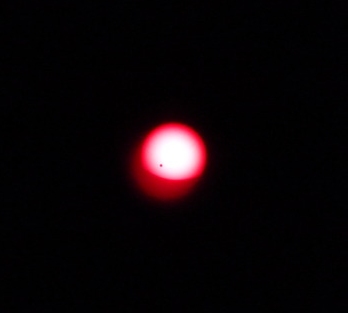
Aberdeen was unfortunately clouded out for the transit of Venus
on the morning of June 6th, however at least 2 AAS members
caught sight of the Transit:
1) Phil Hart viewing from Leipzig, Germany
(pictures
& story) 2)
Karen Yuill viewing from Mullhead on Orkney
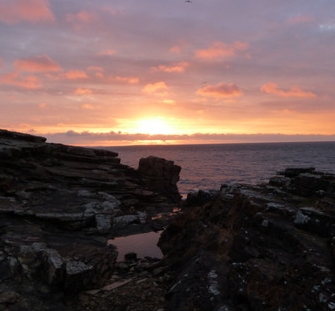
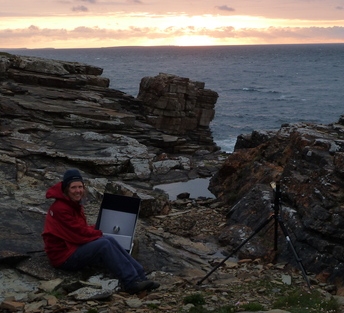
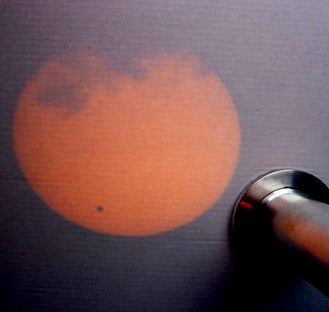
These are some photos of my Transit of Venus experience in Orkney. They
aren't stunning but the conditions were difficult with strong Easterly
winds and almost 95% cloud cover. Pictures include some of our equipment
and viewing position in a small gully near the Gloup, Mull Head to give
us a bit of shelter. In one of the shots of my cardboard Solarscope, you
can see we've had to weigh it down and surround it with stones to try
and keep it from blowing away - as improvised by Roddy!
The PST picture was an improvised hand-held shot just to see if it would
turn out. So far I haven't been able to get my web-cam to work but in
the conditions I'd have been wary of having a laptop set up. Some of the
others show the 2 small strips of clear sky that we had and how the
remaining clouds resulted in a beautiful sunrise even if that meant we
didn't see any more of the transit.
|
|
|
|
Perseid Meteor Shower (12 Aug
2009)
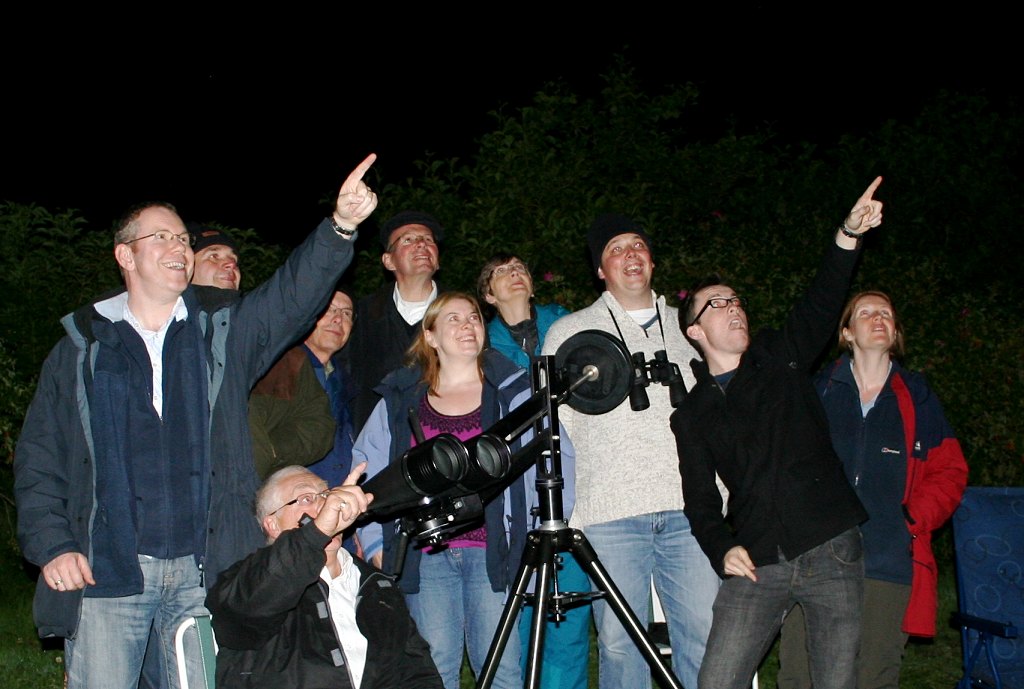
Torcuill
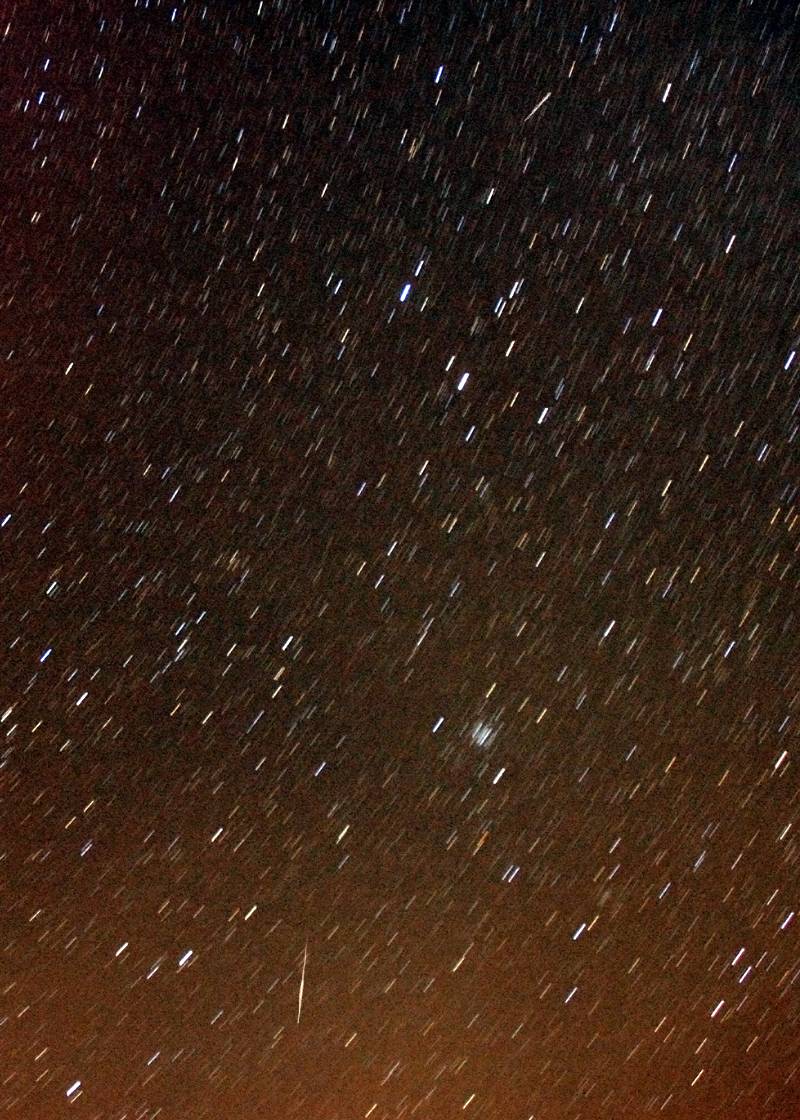
Torrance (left) points out a meteor during the Perseid Meteor
Shower,
following a social event when AAS members and guests' enjoyed a Cosmic
Curry
Back of Bettridge Centre, Newtonhill, 2009-08-12. (click
on image for larger
view)
|
|
|
|
Spring Star Gazing Success (Mar
2009)
Star gazers in Newtonhill were blessed
with clear skies on Saturday night (March 28th) and braved freezing
temperatures to enjoy the Spring Star Watch event organised by Aberdeen
Astronomical Society. About 90 people enjoyed the evening that included
talks on astronomy and telescope observing.
A highlight of the evening was the Cosmic
Dome planetarium run by Christine Macmillan from Techfest-Setpoint, who
gave the audience a guided tour of the night sky before they were then
able to go outside and see the real thing for themselves.
AAS president Darren Moody said "400
years ago Galileo first pointed a telescope at the planet Saturn. On
Saturday night we were able to give many people their first close-up
look at Saturn, showing them the famous rings and some of Saturn's
moons. Other objects on view included the Pleiades star cluster and the
Orion Nebula. Early guests also had the opportunity to see the Moon
through telescopes, as well as watch a flyover of the International
Space Station. The evening was a great success and we hope to make this
a regular event. The Bettridge Centre is an ideal venue for indoor
astronomy activities and outdoor star gazing. We'd particularly like to
thank Newtonhill Out of School Club for making some fantastic astronomy
posters to decorate the hall for the evening.
Spring Star Watch
Event (March 28th 2009)
The International Year
of Astronomy 2009 (IYA2009) is an exciting global celebration of astronomy and
its contributions to society and culture. Coinciding with the
400th anniversary of Galileo's first glimpses through a telescope and the birth
of modern astronomy, it gives people all over the world the chance to get
involved in this fascinating science and experience the wonders of the night
time sky.
IYA2009
links
| UK : http://www.astronomy2009.co.uk/
|
Global :
http://www.astronomy2009.org/ |
|
|
|
|
Big Binos in Action (Dec 2008)
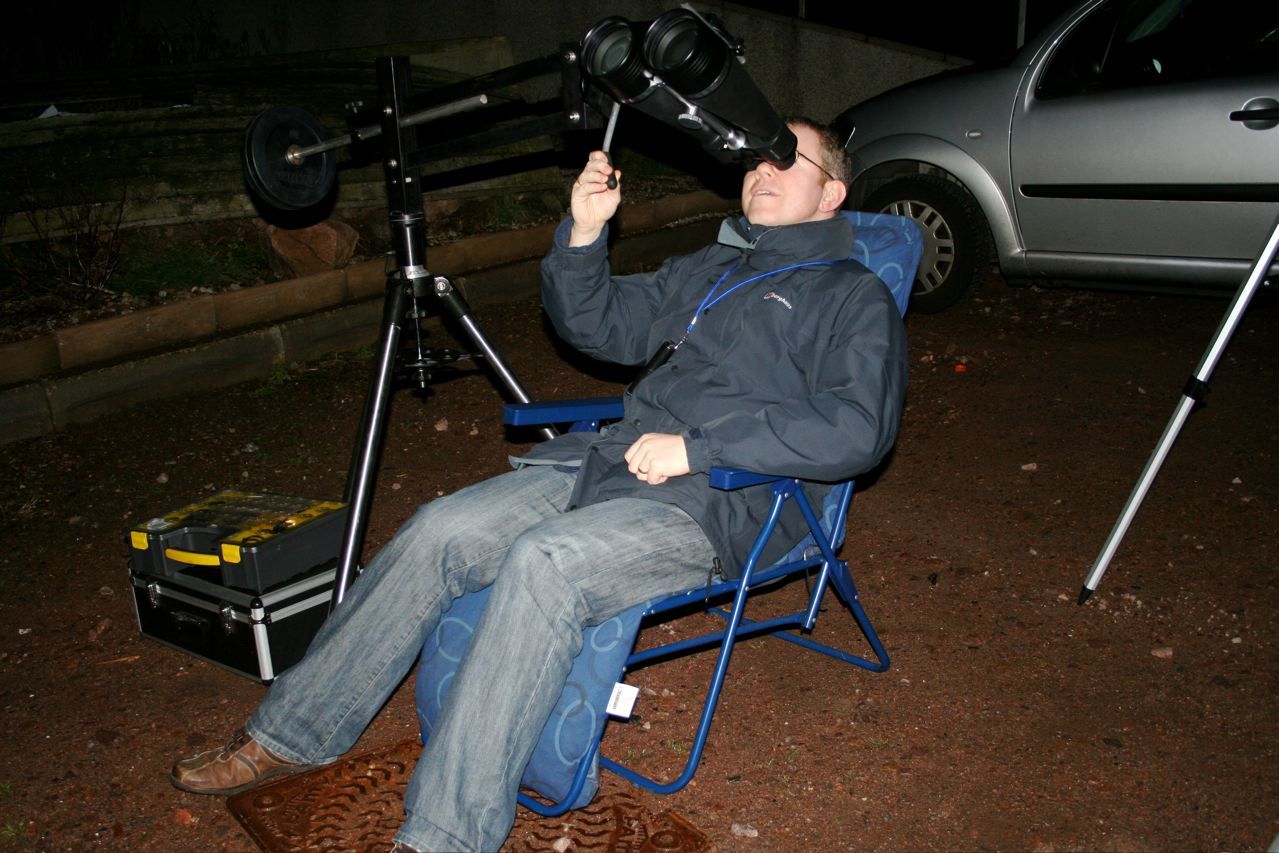
AAS Project Officer, Torcuill Torrance,
taking a look at the night sky using our very large (25x100) binos on a
Millennum Unimount stand which allows him to glide his view around the
sky with the greatest of ease. Bettridge Centre, Newtonhill
Photo Credit: David Croston (Dec
2008)
|
|
|
|
Visit to Stirling Observatory /
Old High School Telescope (13 Sep 2008)
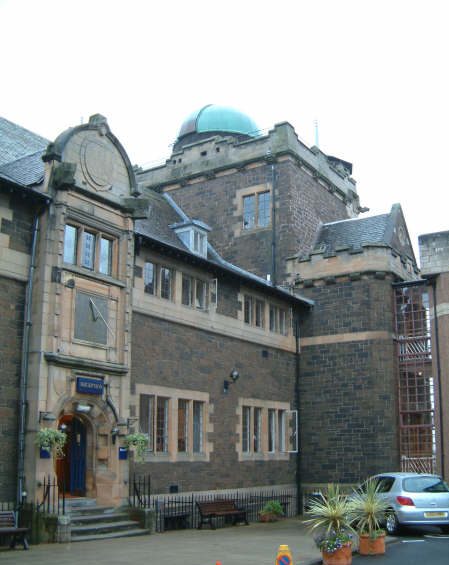
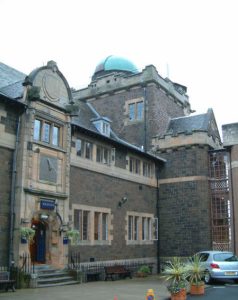
The Observatory Tower
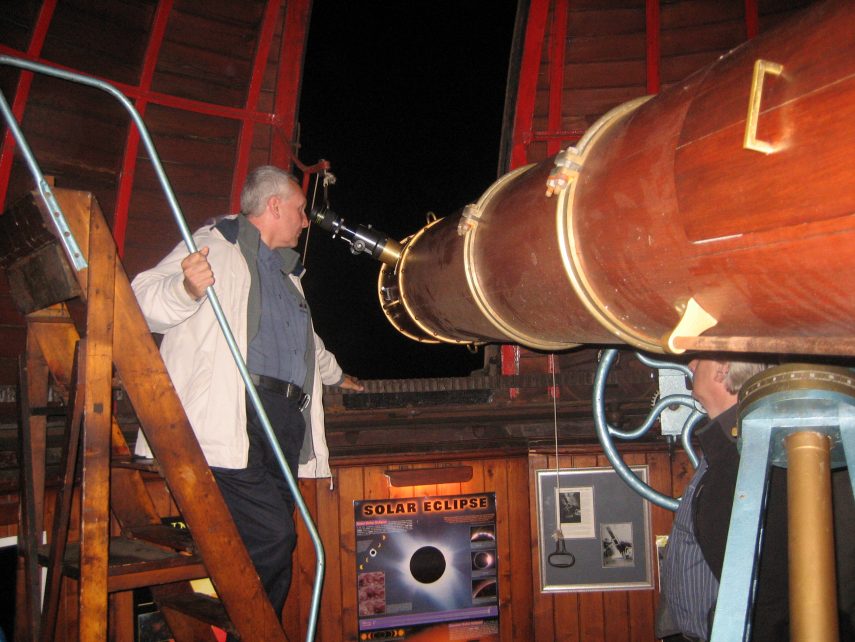
atop the Stirling Highland Hotel. |
|
AAS member Jeff Fysh enjoying the
view through
the 12" Newtonian reflector built in 1889 by William Peck |
 |
|
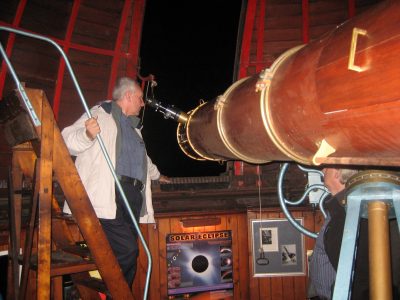 |
On Saturday 13th September, 13 AAS members travelled down
to Stirling for a very enjoyable visit to the observatory operated by Stirling
Astronomical Society. Before a tour of the observatory we enjoyed a
meal at a local Indian restaurant with 5 members of SAS, helping to forge
links between the two astronomical societies.
Despite cloudy skies, Alan Cayless and other members of
SAS entertained us with the stories of the Old High School Telescope that
sits in the observatory atop the Stirling Highland Hotel. The telescope
was designed, constructed and installed in the High School of Stirling by
William Peck in 1889. However, despite good early use, the observatory
fell into disuse in the early 20th Century and the telescope lay in
storage gathering dust for many decades. In 1962 the High School relocated
to new premises and the building was empty until 1989 when conversion to
the present hotel started. Stirling Astronomical Society have done a
tremendous job of restoration of the telescope and observatory and have a
busy time showing it to local schools, groups, hotel guests and the
occasional astronomical society.
Alan also has an involvement in the Open University and
treated us to a slide show of an observatory that they use in Majorca
every year. Clearly they have better skies there than we had in Stirling
that night and no doubt a few AAS members are adding this venue to their
holiday wish list.
The cloudy skies didn't stop us admiring the observatory
and the superb view over the surrounding city. The telescope was aimed at
the floodlit Stirling Castle and Wallace Monument and we were impressed by
the quality of the optics that William Peck had made all those years
ago.
Late in the evening we headed for home and noted with our
usual displeasure that the skies were gradually clearing!
Our visit coincided with the busy Stirling Open Doors
weekend that the observatory was a part of, so AAS is very grateful to
Alan Cayless and the other members of Stirling Astronomical Society for
taking the time to show us the observatory and tell us about it's history.
We can't recall a previous official AAS visit to this observatory, but
we're sure it won't be long before we visit again.
Darren Moody
Links : http://www.stirlingastronomicalsociety.org.uk/
|
|
|
|
Perseid Meteor Observing by AAS Members
(11/12 Aug 2008)
Two AAS Members observed 43 Perseids over a 3 hour period from
the Bettridge Centre, Newtonhill with rates of up to 22 per hour.
Another AAS member observed from the society's Dark Sky Site and saw 5
meteors over a 1-2 hour period. Individual reports follow:
1: Initial conditions looked better down towards the coast and
I joined Torc at the Bettridge Centre. Some early clouds thinned out to
give clear skies (much better than I thought there would be). It looked as
though it probably would have been OK inland too. We found a very pleasant
spot where a hedge screened the Bettridge Centre lights and left us with a
view of sea and stars. First meteor appeared about 10:30 pm (BST). I
counted 18 Perseids in the first hour and 22 in the second hour. Not bad
12 hours ahead of the peak. Regrettably I had to head for home at 12:30
am, knowing that I had to work today. Torc carried on watching and
photographing. (Darren Moody). 2:
I stayed up for another hour - seeing 3 further meteors, but taking many
many unfocused, wrongly exposed images of the inside of my dew laden lens.
Haven't had so much fun for ages! (Torcuill Torrance).
3: Guess who was Mr Lonely again.
I got to the (Dark Sky) site around 10:00 pm as from home the sky was
beginning to clear. By 11:00 I had about 50% clear sky. As for Perseids,
very few. Saw 5, one very fast and bright blue in colour which covered
about 1/3 of the sky in length. A couple of tumbling satellites and by
midnight, some great views of the Milky Way. At which point, beginning to
imagine the black cougar of Correnie coming up behind me, I ate the last
of the coconut cookies and finished off the hot chocolate and went home -
as also having to work today (Chris Higgins).
|
|
|
|
AAS Dark Sky Site (Aug 2008)
An account of the founding and use of the AAS Dark Sky Site by
Phil Hart (Tales
from Scotland: The Value of a Dark Sky Site) has been published in
Crux - the newsletter of the Astronomical
Society of Victoria.
|
|
|
|
Noctilucent Clouds (June 19th, 2008)
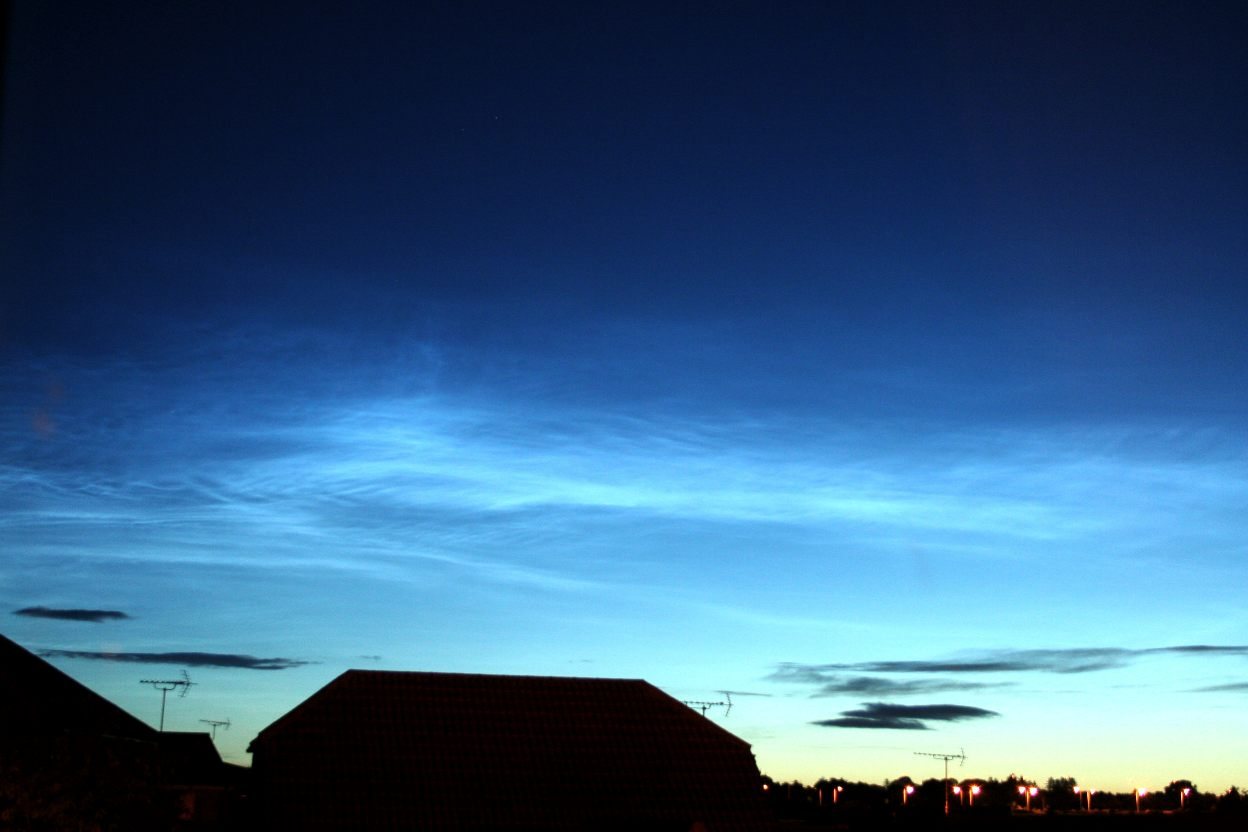
Bright display of noctilucent clouds visible on June 19th. Images
below and a 5
MB video were recorded by AAS member Torcuill Torrance from Newtonhill.
Torc's pictures
and a 5
MB video made there way onto the top story slot on the June
23rd edition of spaceweather.com and the 2008
Noctilucent Cloud Photo Gallery
|
|
|
|
Night at the Museum Event (17 May
2008)
Night at the Museum Event held at the Zoology Museum and
Natural History Centre on the University of Aberdeen's historic King's
College campus. Interactive festivities included star and planet gazing
with the Aberdeen Astronomical Society

|
|
|
|
Dark Sky Observing Meeting (07
Sep 2007)
Five member of the society had
a very enjoyable evening up at Dark Sky site on Friday evening. The early
evening sunshine suggested good conditons for the dark hours, so we were
initially disappointed with total cloud cover when we arrived at 9:30 pm.
Patience paid off though as good clear spells materialised within an hour
and we spent a good couple of hours with a few telescopes and one of our
new 25x100 binoculars. It
was good to see that the old favourites are still there (M13, M27, M57,
etc.). I was pleasantly surprised at how many of these could be picked up
with the binoculars. In particular the view of the Double Cluster in
Perseus was breathtaking, as was the Andromeda Galaxy, M31. Just scanning
the Milky Way through Cygnus threw up numerous delights. [D.Moody]
|
|
|
|
Phil Hart wins Honourable
Mentions for astrophotos at prestigious "David Malin Awards",
2007. Phil Hart recently entered a number of his astro-images
in the fourth annual David Malin astrophotography competition, hosted by
the Central West Astronomical Society in Parkes, NSW, and came away with
three honourable mentions in the Amateur Deep Sky and Amateur Solar System
categories. >> Picture
of Phil Hart with David Malin
|
|
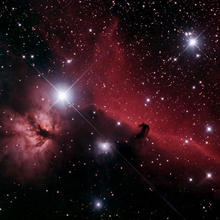
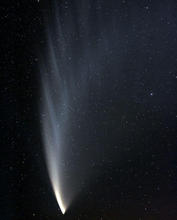 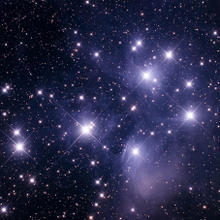
Photo Copyright: Phil Hart
[More http://www.parkes.atnf.csiro.au/events/astrofest/awards/
]
|
|
|
Perseid Meteor Observing by AAS Members (12/13
Aug 2007):
Although cloud prevented meteor observing from the inland Dark Sky site, a
number of AAS members saw Perseids in breaks in cloud from various
locations around Aberdeen.
| Date |
Observation (Times below are BST) |
| 12/13th Aug |
Last night was clear for quite a while. I managed
to observe 5 Perseids and one erratic from 10:45 to 11:30 pm. Then
the clouds rolled in.
[Chris Higgins, Craigievar] |
|
|
|
Cloud. Perseids was a no-show for me. [Darren
Moody, Bancory] |
|
|
|
Clocked up a nice total of 16 meteors over a 45
minute period at our alternative viewing location near Doonies
Farm, Altens. [Torcuill Torrance / Andrew Crockford
] |
|
|
|
Braved the light polluted skies of our urban back
garden in Stonehaven to check out these Perseid things between
about 0045 and 0115 (BST). We saw 8 meteors including one
spectacular and lingering fireball before the clouds rolled in [David
Croston, Stonehaven] |
|
|
|
Pretty pleased with our haul of 20 in an hour + one
sporadic. Cloud cover initially was almost total but cleared to
give a reasonable chunk of clear sky which swept across from south
to north [Karen
Yuill, Balmedie] |
|
|
|
Cloudy each time I looked out. [David Richards, Newburgh] |
|
|
| 13/14th Aug |
Clear skies tonight. Although I was mainly
occupied with CCD imaging, I noted that the Perseid's were
putting on quite a good show (around 30 plus over a 3.25 hour
period, 23:30 to 02:45 BST). No fireballs, but occasional flurries
with 3 to 5 meteors over a two minute period. [David Richards, Newburgh] |
|
|
|
|
|
|
Observing Meeting, Woodbank (27
Apr, 2007)
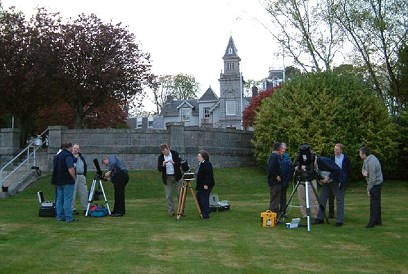
Around 12 members of
the society met at Woodbank and using three telescopes between
3.5 and 8" diameter viewed Moon, Venus and Saturn in the
early evening event.
|
|
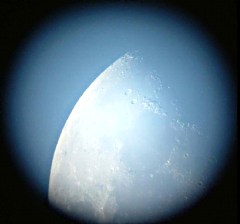
Moon through telescope,
digital image (Paul Nesvadba)
|
|
Pictures from Observing Meeting
at Woodbank (Apr 27th)
Pictures by Paul Nesvadba. Click on images for larger picture. 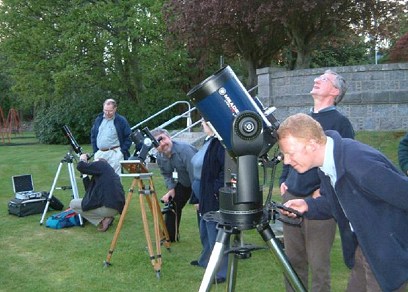
|
|
|
|
Public Observing Session, Lunar
Total Eclipse (3 Mar 2007)
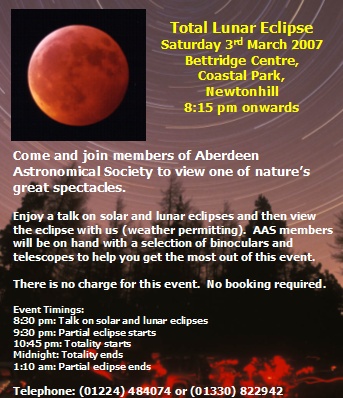
A large crowd of people enjoyed a spectacular view of the total
lunar eclipse on Saturday 3rd March from the Bettridge Centre in
Newtonhill. About 80 people joined members of Aberdeen Astronomical
Society for the event, enjoying a talk on eclipses, a tour of the night
sky as well as a great view of the eclipse through an array of telescopes
and binoculars. Earlier in the evening, AAS President
Darren Moody had described what happens during eclipses, giving the
audience a good feel for what to expect as the show progressed. As the
Earth's shadow crept across the face of the Moon, the sky gradually got
darker, more stars began to appear and the Moon took on a dark red tinge.
At the moment of totality, just before 11 pm, there were even some cheers
from the crowd that consisted of young and old as well as local and
foreign visitors. Darren Moody added "The view
through binoculars was spectacular, with the Moon's colours varying from
coppery-red to yellow to bluish-grey at the edges. The Moon takes on this
unusual colour as sunlight is bent through Earth's atmosphere to
illuminate the Moon." Some clouds blocked the view for a few minutes,
but these soon cleared leaving an uninterrupted view until the main part
of the eclipse ended at 1:10 am. The enthusiastic crowd also enjoyed views
of Saturn, the Orion Nebula and numerous constellations and star clusters.
AAS member and Newtonhill resident Torcuill Torrance said "It was a
spectacularly successful evening. There was a real buzz about the
event.". 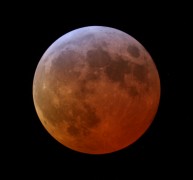
See more Gallery Pictures of
Total Lunar Eclipse
|
|
|
|
|
|
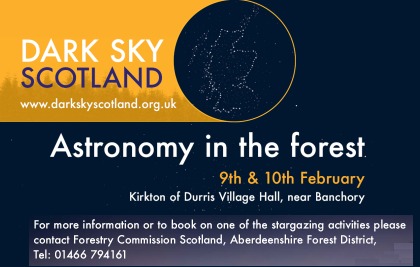
Dark Sky Scotland Event, Durris
(9/10 Feb 2007)
Report to be added shortly.
|
|
|
Geminids Meteor Observing by AAS Members (13 Dec 2006):
Several members of AAS enjoyed a clear, windy, but surprisingly mild night
(temperatures a balmy 11 degrees C) for the peak of the annual Geminids
meteor shower on December 13th. The peak was not forecast to occur until
about 8 am on the 14th, but judging by the counts we made, the peak
appears to have arrived early. A grand total of 652 Geminids were counted
between 9:20 pm and 2:50 am, when clouds finally started to arrive. The
breakdown of this count is as follows:
9:20-10:20 pm: 60 Geminids (3 observers)
10:20-11:20 pm: 135 Geminids (4 observers)
11:20-12:20 am: 155 Geminids (3 observers)
12:20-1:20 am: 150 Geminids (2 observers)
1:20-2:20 am: 100 Geminids (2 observers)
2:20-2:50 am: 52 Geminids (2 observers and increasing cloud).
This ties in really well with the peak that is showing up in early
reports on the IMO website (http://www.imo.net/),
where a peak ZHR of 110 is recorded at 1 am. [ZHR is defined as
being for a single observer (you're not really supposed to combine the
counts of more than one person), but the peak rate of 110 agrees quite
well with our observations]
This probably ranks as one of the best nights of meteor observing we've
had at AAS since the Leonid events of a few years ago.
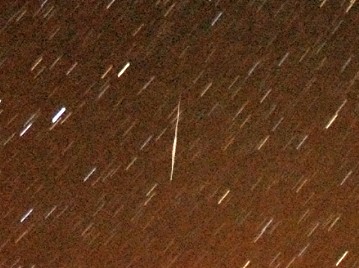
Picture of
Geminid Meteor by Alisdair Farquhar
14-Dec-2006 | Larger
picture
|
|
|
Leonid Meteor Observing by AAS Members (18/19 Nov
2006):
After cloud cleared a number of AAS members observed the Leonid Meteor
Shower on the night of Nov 18th/19th from locations west and north of
Aberdeen city. Reports for morning of Nov 19th, when taken together
are consistent with an increase in meteor count around the time of the
predicted peak (04:45 hUT):
| Time (hUT) |
Observation |
| 00:00 - 01:00 |
Very Few Leonids [Darren Moody,
Banchory] |
| 02:15 - 04:15 |
Observed S/SW from window in house. 2 Leonids plus
1 sporadic [David Richards, Newburgh] |
| 04:15 - 05:30 |
Increase in frequency, 8 Leonids in period, most
fairly faint and short. Limiting mag ~ 4.5. [David
Richards, Newburgh] |
| 04:25 - 05:25 |
I counted 22 Leonids in the hour, which is slightly
lower than what I expected. Skies were very clear probably down to
about mag 5.5. Light pollution and slight haze may have drowned
out some faint meteors. Estimated ZHR ~ about 60. [Darren
Moody, Banchory] |
| 04:30 - 06.15 |
31 Leonids in timeframe plus about 5 sporadics. 1
really bright Leonid in Virgo that left a trail that stayed around
for about 5 seconds at 5.54am. Some light pollution so some
fainter ones may have been missed altogether [Karen
Yuill, Balmedie] |
|
|
|
|
Dark Sky Observing (Sat, 21 Oct 2006) - Orionids
Meteor Shower and Comet Swan : Despite the poor weather during
the day, skies finally cleared for a couple of hours on Saturday evening
allowing observing of the Orionid Meteor Shower. Before the radiant rose
and meteor activity started I took the opportunity to observe Comet Swan
low in the north-west. I didn't have my telescope with me, as the dampness
of the air and ground would have led to a constant battle with dew. I had
a good look through binoculars and could just make out a tail to the
comet, which was in the constellation Bootes at the time. Started meteor
counting at 10:30 pm. I counted 13 meteors up until about midnight, when
clouds came across and ended the session. One or two of these were bright
with trains that persisted for a couple of seconds. This number was about
what I expected for this moderate meteor shower with a radiant that had
only just risen. [Darren Moody, Midmar Dark Sky Site]
|
|
|
|
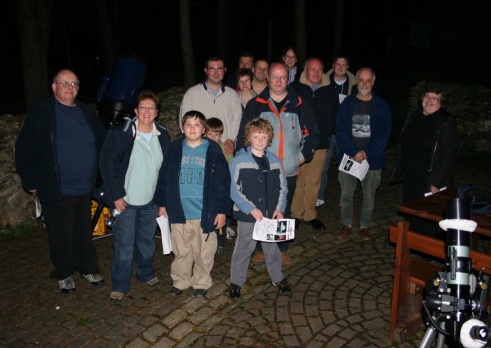
Successful Public Observing Night (30 Sep 2006) :
On Saturday 30th September, AAS held a very successful public observing
night for the Aberdeenshire Council Ranger Service at the Bennachie
Centre, near Chapel of Garioch. Despite clouds threatening from the west
at sunset, skies were completely clear by the time full darkness fell.
About 25 people came along to enjoy a talk on the subject "Pluto and
Beyond" followed by a guided tour of the autumn night sky. The main
objective of the evening was to give people the opportunity to experience
the night sky through a variety of telescopes. Among the objects viewed
were the Andromeda Galaxy, the Ring Nebula, the Hercules Globular Cluster,
the double star Albireo, the galaxies M81 and M82, the Perseus Double
Cluster and the North America Nebula. We even arranged for a meteor to fly
past just as we were pointing out a satellite! The next public observing
event will probably be timed to coincide with the total lunar eclipse in
March 2007, so watch this space.
|
|
 |
|
|
|
Dark Sky Observing (26 Aug 2006) :
Last night's star party had a record of 7 'scopes setup, with another 6 or
7 pairs of binoculars to boot - including a larger pair of 25x80's for
fun. We seemed to have a good mix of Maksutov-Cassegrain/Schmidt-Cassegrain
goto's, a very nice refractor with a whopping 2-inch eyepiece and a
selection of reflectors.
The group observed a variety of objects ranging from old favourites
like M57 The Ring Nebula, Saturn Nebula, Dumb-bell, Pinwheel, Pegasus
Cluster, M2, M73, M72, M29, M13, M92, M33/4, M32/110/31, Whirlpool Galaxy,
Wild Duck Cluster, The Pleiades, and Torc's first sighting of Neptune. It
was noted that the variable star Chi Cygni in Cygnus seems to have died
down considerably. Bodes and the Cigar Galaxy also made it onto the
viewing lists.
Everyone was able (and encouraged!) to look through other 'scopes and
eyepieces, with many a "credit-card-damaging" mental note being
taken. The weather was extremely kind, it was almost completely clear
until we got too tired past 2 am. There was one small cloud that was
hovering to the south but it seemed to get thinner as the night wore on.
In all everyone had a great time - and Andrew has brought a new snack, the
KG007 sandwich - its Meteor!
Lets hope this is just the start of a great observing season.
|
|
|
|
Cloud obscures view of Perseid Meteors (12 Aug
2006) :
The annual Perseid meteor shower is usually taken as the start of the new
AAS observing season and allows us to watch the skies in the relative
comfort of slightly warmer evenings. The timings of the meteor shower were
ideal for UK observers this year, with a predicted peak occurring just
after midnight (and it was a Saturday night).
We always knew that we would
be battling against the moonlight to see many meteors, but we would have
been happy to put up with it. As it turns out, complete cloud cover and
drizzle prevented the three optimists who turned up at the dark sky site
from even seeing the Moon. The peak of the Perseids seems to have fallen
in the middle of a week without any clear skies, so there are no reports
of any meteors from the Aberdeen area.
Hopefully we'll have better luck
with the Leonids and the Geminids.
[ See pictures of what we missed on SpaceWeather
photo gallery ]
|
|
|
AAS Revised Logo (Jul 2006) : |
|
|
|
[ AAS Logo with
words - Sept 2007 ] |
AAS Web Site receives fresh look (Jul 2006) :
AAS Web Site updated with a fresh look and a move to new site (www.aberdeenastro.org.uk) |
|
|
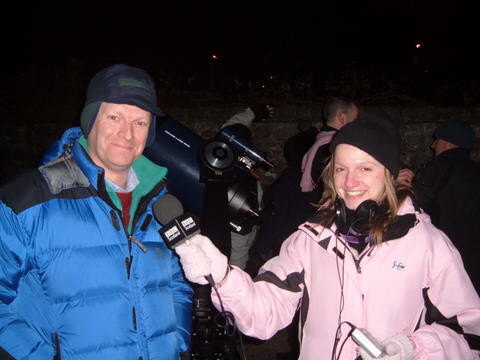
Radio Scotland Feature : AAS Stars on Radio Scotland ! In December 2005, Aberdeen Astronomical
Society featured on the Radio Scotland programme "Out of Doors".
Radio presenter Joanna Rae came along to one of our Woodbank meetings to
find out what amateur astronomers get up to at night! Skies were
clear (and temperatures were sub-zero!) and we were able to show her Mars and other
celestial delights through the telescopes. This was probably our
best Woodbank turnout, with about 20 people there. |
|
|
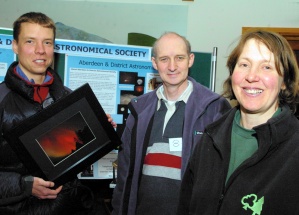
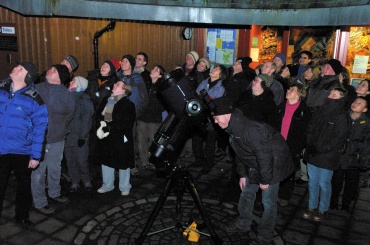
Public Observing Evenings : Our public observing evenings are becoming very popular.
Unfortunately we can't always get rid of the clouds. One of our
events last year at the Bennachie Centre was a tremendous success! Despite the frequent snow showers, a
large crowd were able to observe the planet Saturn, which was high in
the sky at the time. At the event AAS president John MacNicol
presented The Forestry Commission's Jackie Cumberbirch with a framed
aurora photograph taken by Phil Hart from our dark sky site in recognition
of their permission to allow AAS to use the site. |
|
Photos courtesy of Aberdeen Journals Ltd.
|
Return to Top
 |
|
|
|
Older
AAS News Items (2005) > |
|